
Boris I of Bulgaria
Ruler who Christianized Bulgaria and fostered Slavic literacy.

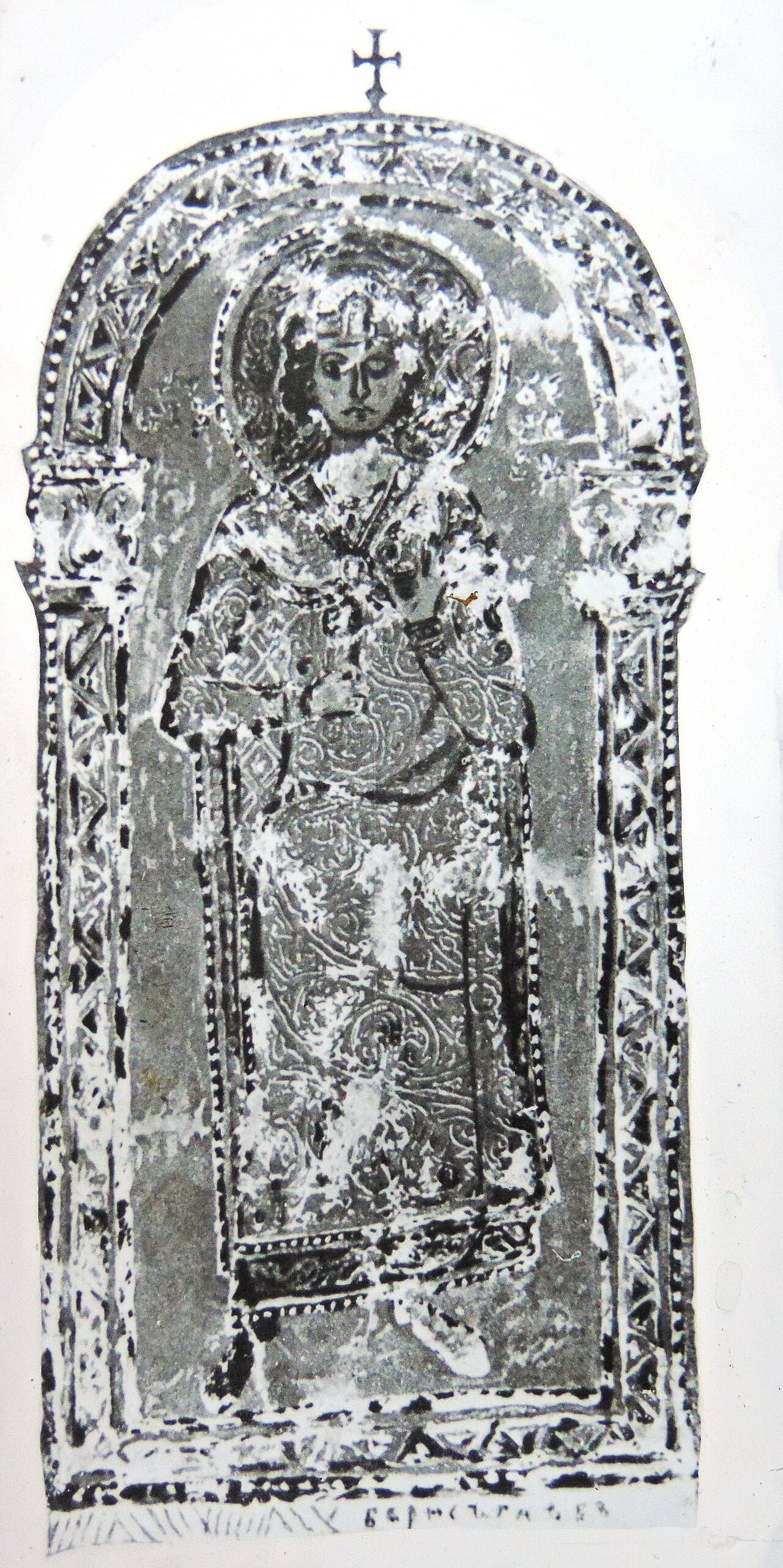
Constantine of Preslav · Public domain
Boris I (also Bogoris), venerated as Saint Boris I (Mihail) the Baptizer, was the ruler (knyaz) of the First Bulgarian Empire from 852 to 889. Despite a number of military setbacks, his reign was marked with significant events that shaped Bulgarian and European history, including the Christianization of Bulgaria in 864 and the establishment of an autocephalous Bulgarian Church.
- died
- 2 May 907
- field
- Ruler, Christianizer
- nationality
- Bulgar
- known_for
- Christianization of Bulgaria, patronage of Slavic script
- title
- Knyaz (also Khan/Kanasubigi before baptism, later Tsar retrospectively)
Lore & Background
Boris I was the son and successor of Presian I, though the exact relationship is uncertain and not definitively established in all sources. In 852 he sent emissaries to Eastern Francia to confirm a peace treaty. His early reign saw military setbacks: a failed campaign against East Francia in 854, a war with the Croats, and a conflict with Byzantium in 855–856 that cost him Philippopolis, Zagora, and Black Sea ports. In 853 or 854, his son Vladimir-Rasate led an invasion of Serbia but was defeated and captured; peace was later made with the Serbian ruler Mutimir, though the capture and peace are not consistently recorded in all primary sources.
Boris converted to Christianity in 864, motivated by diplomatic pressures and a Byzantine invasion during famine. He was baptized by Byzantine clergymen, with Emperor Michael III as his godfather, adopting the Christian name Michael; the location of the baptism is not definitively established—it may have occurred at Pliska, Constantinople, or elsewhere. He exploited the conflict between Constantinople and the Papacy to secure an autocephalous Bulgarian Church, addressing nobility's concerns about Byzantine interference.
After abdicating in 889, his eldest son tried to restore paganism but was deposed by Boris. The subsequent Council of Preslav adopted Old Church Slavonic as the church language and began a gradual replacement of Byzantine clergymen with native Bulgarians. In 885, Boris gave refuge to disciples of Saints Cyril and Methodius, helping to preserve the Glagolitic script and fostering Slavic literature; the promotion of the Cyrillic script is more closely associated with his son Simeon I.
Reader's Guide
Boris I's reign fundamentally transformed Bulgaria and the Slavic world. His Christianization in 864 ended paganism and aligned Bulgaria with Christian Europe, while his diplomatic skill secured an independent Bulgarian Church, preventing Byzantine domination. By sheltering the disciples of Cyril and Methodius after their expulsion from Great Moravia, he preserved the Glagolitic script and enabled the development of Cyrillic script and Old Church Slavonic literature, which became the liturgical and literary language for many Slavic peoples. His abdication and subsequent intervention to suppress a pagan revival ensured the permanence of Christianity. The Council of Preslav further solidified a native Bulgarian clergy and language, shaping national identity. Boris is venerated as a saint in the Orthodox Church, titled Equal-to-the-Apostles, with his feast day on May 2. His legacy as the Baptizer of Bulgaria and patron of Slavic letters endures in religious and cultural history.
Did You Know?
- Boris I adopted the Christian name Michael after his baptism, with Emperor Michael III as his godfather.
- He gave refuge to the disciples of Saints Cyril and Methodius in 885, helping to preserve the Glagolitic script.
- After abdicating in 889, he deposed his eldest son for attempting to restore paganism.
- His title before baptism may have been Khan or Kanasubigi, and after baptism Knyaz.
- The promotion of the Cyrillic script is more directly linked to his son Simeon I than to Boris himself.
Deep Roots: Prehistoric Bulgaria
The lands that would become Bulgaria hold some of the oldest traces of human presence on the continent. In the Kozarnika cave, researchers uncovered human remains dating back roughly 1.6 million years, and the site likely preserves the earliest known evidence of symbolic behaviour by any human group. A pair of fragmented jaws recovered from Bacho Kiro cave is about 44,000 years old, though scholars still debate whether those early inhabitants were anatomically modern humans or Neanderthals. Moving into the Neolithic, the Stara Zagora dwellings from around 6,000 BC rank among the oldest purpose-built structures anywhere. The region also gave birth to the Karanovo, Hamangia, and Vinča cultures, while Solnitsata stands as what is considered the earliest known town in all of Europe. At Durankulak lake, a settlement began on a small island around 7000 BC, and by 4700 BC stone construction was already widespread — a building tradition unique to Europe at the time. The Eneolithic Varna culture, emerging around 5000 BC, represents Europe's first society with a clear social hierarchy. Its necropolis, excavated in the early 1970s, yielded golden rings, bracelets, and ceremonial weapons crafted between 4600 and 4200 BC, making them the oldest gold artefacts known from anywhere in the world.
The Thracian World and Its Cultural Identity
The Thracians were the first people to leave a lasting cultural imprint across the region, though their precise origins remain a mystery. Most scholars propose that a proto-Thracian identity emerged when Indo-European speakers, expanding during the Early Bronze Age around 1500 BC, conquered and blended with the indigenous populations already living there. The Thracians inherited the metalworking expertise of those earlier civilisations, particularly in gold craftsmanship, and despite never developing their own written script, they maintained a remarkably sophisticated culture. Politically, the tribes were generally fragmented and disorganised, yet when external threats pressed upon them, they could forge powerful military coalitions. They avoided the urban model that Greek colonists brought to places like Byzantium and Apollonia, preferring instead large fortified settlements that doubled as regional market centres. The first Greek colonies in Thrace appeared in the 8th century BC, and it was not until the Roman period that a true urban concept took root in the region.
The Persian Encounter with the Balkans
The Achaemenid Persian Empire left a deep mark on the Balkans beginning in the late 6th century BC. After Macedon's king Amyntas I submitted to Persian authority around 512–511 BC, the stage was set for a far larger incursion. In 513 BC, Darius the Great dispatched a vast army into the Balkans, attempting to defeat the Scythian groups roaming north of the Danube. The force subjugated numerous Thracian peoples and swept across every region bordering the European Black Sea — parts of modern Bulgaria, Romania, Ukraine, and Russia — before withdrawing to Asia Minor. Darius left his commander Megabazus behind to consolidate gains in the Balkans; Megabazus conquered gold-rich Thrace, the coastal Greek cities, and the powerful Paeonians, then compelled Amyntas to accept Persian overlordship. The Ionian Revolt temporarily weakened the Persian grip, but Mardonius firmly restored it in 492 BC. The Balkans, including present-day Bulgaria, supplied soldiers to the multi-ethnic Achaemenid war machine. Eastern Bulgaria remained under Persian control until 479 BC, and the garrison at Doriscus reportedly held out for years after the main defeat, becoming the last Persian stronghold on European soil.
Modern Bulgaria in the European Framework
After millennia of shifting empires and cultural layers, modern Bulgaria has steadily integrated itself into the core structures of contemporary Europe. The country became a member of NATO on 29 March 2004, marking its formal alignment with the transatlantic security architecture. Three years later, on 1 January 2007, Bulgaria joined the European Union, gaining access to its single market and institutions. The integration process continued with Bulgaria's entry into the Schengen Area on 1 January 2025, removing internal border controls and facilitating free movement across the zone. The most recent milestone in this sequence is the adoption of the euro on 1 January 2026, replacing the national currency, the Bulgarian lev, and completing Bulgaria's full monetary union with the rest of the eurozone. Together, these steps trace a clear trajectory from a post-communist state on Europe's periphery to a fully embedded member of the continent's political, economic, and security frameworks.
Gallery
Frequently Asked Questions
Who is Boris I of Bulgaria?
Boris I, also called Bogoris, served as the knyaz (ruler) of the First Bulgarian Empire between 852 and 889 and is remembered as a saint for guiding his people into the Christian faith.
What role did Boris I play in the Christianization of Bulgaria?
In 864 he formally adopted Christianity for the Bulgarian state and went on to negotiate the establishment of a self-governing Bulgarian Church, freeing it from external ecclesiastical control.
How did Boris I's life end?
He was killed in a palace coup on 2 May 907, when his own son Simeon seized the throne.
Why does Boris I matter in European history?
By bringing Bulgaria into the Christian fold in the mid-ninth century, he permanently shifted the kingdom's cultural and diplomatic orientation toward the rest of medieval Europe.
What did Boris I do to promote Slavic literacy?
He championed the use of the Slavic alphabet in Bulgaria, helping to build a written literary culture in the vernacular language rather than relying solely on Greek.
More in Reformers And Leaders Of The Americas And Beyond 25-28
Elsewhere in the Reformers And Leaders Of The Americas And Beyond universe
Spotted an error? Know more?
This is a living reference — every entry is fact-audited, and reader corrections feed straight into our audit queue. Suggest an edit · See this site's audit record